 Language
 English
 русский
 Español
 عربى
عربى
Industry News
What is a Stadium Light?
A stadium light refers to a high-power, high-efficacy, high-reliability lighting system specifically designed for large sports venues and athletic fields. It is used to meet the lighting requirements of various scenarios, including professional competitions, training sessions, television broadcasts, spectator viewing, and entertainment events.
Content
- 1 1. What is a Stadium Light?
- 2 2. Main Components of a Stadium Light
- 3 3. Key Features of Stadium Lights
- 4 4. Comparison with Traditional Metal Halide Stadium Lights
- 5 5. Applications of Stadium Lights
- 6 6. Key Design Parameters for Stadium Lighting
- 7 7. Common Installation Methods for Stadium Lights
- 8 8. Selection Guidelines & Industry Trends
1. What is a Stadium Light?
A stadium light is a high-intensity lighting fixture used in indoor or outdoor sports venues. It typically uses high-power LED light sources or traditional metal halide (MH) lamps. Unlike standard street lights or general floodlights, stadium lights must meet stringent lighting standards, including:
High Illuminance: Meets the visual needs of athletes, referees, spectators, and camera equipment
High Uniformity: Even light distribution across the entire playing area, avoiding dark spots or excessive brightness variations
Glare Control: Minimizes direct light interference with athletes and spectators
High Color Rendering: Ensures accurate color reproduction, especially critical for high-definition television broadcasts
Instant Start & Dimming: Supports rapid switching and brightness adjustment to accommodate different events and activities
High Reliability: Stable operation during extended runtime and under adverse weather conditions
2. Main Components of a Stadium Light
|
Component |
Description |
|
LED Light Source Module |
Integrates multiple high-power LED chips to deliver high luminous flux; luminous efficacy typically reaches 150–200 lm/W |
|
Optical Lens / Reflector |
Provides precise light distribution with adjustable beam angles (narrow, medium, wide) to ensure accurate light projection onto the playing area |
|
Thermal Management System |
Uses fin-type heat sinks or active fan cooling to ensure stable LED chip operation at high temperatures, extending lifespan |
|
Driver / Power Supply |
Provides constant current drive; features surge protection, over-voltage protection, and dimming interfaces (e.g., 0–10V, DALI, DMX) |
|
Housing |
Typically made of high-strength die-cast aluminum with anti-corrosion coating; ingress protection rating of IP65 or IP66, impact resistance rating of IK08 or higher |
|
Mounting Bracket |
Adjustable bracket to accommodate various installation methods (e.g., poles, catwalks, roofs) and aiming angles |
3. Key Features of Stadium Lights
|
Feature |
Description |
|
High Luminous Efficacy |
LED stadium lights achieve 150–200 lm/W, saving 50%–70% energy compared to traditional metal halide lamps |
|
Precise Light Distribution |
Multiple optical lens options available, including symmetric and asymmetric distributions, to precisely control beam shape and coverage |
|
High Color Rendering |
Color Rendering Index (CRI) typically ≥80; professional competitions and TV broadcasts require CRI ≥90 |
|
Glare Control Design |
Utilizes visors, honeycomb louvres, and precision cut-off designs to reduce glare and improve visual comfort for athletes and spectators |
|
Intelligent Control |
Supports DMX512, DALI, 0–10V dimming protocols; integrates with lighting control systems for scene switching, zoning, timing, and other functions |
|
Long Lifespan |
LED light source lifespan reaches 50,000–100,000 hours, significantly reducing maintenance frequency and costs |
|
High Weather Resistance |
Ingress protection rating IP65/IP66; resistant to salt spray, UV radiation, and wind loads, suitable for long-term outdoor use |
4. Comparison with Traditional Metal Halide Stadium Lights
|
Parameter |
Metal Halide (MH) |
LED Stadium Light |
|
Luminous Efficacy |
80–100 lm/W |
150–200 lm/W |
|
Lifespan |
6,000–12,000 hours |
50,000–100,000 hours |
|
Color Rendering Index (CRI) |
60–80 |
80–95 |
|
Start-up Time |
5–15 minutes warm-up; hot restrike requires cooling |
Instant start; supports frequent switching |
|
Dimming Capability |
Poor |
Excellent (0–100% smooth dimming) |
|
Glare Control |
Moderate |
Excellent (precision cut-off design) |
|
Maintenance Cost |
High (frequent lamp replacement) |
Low (long lifespan, modular design) |
|
Intelligent Control Integration |
Difficult |
Easy (DMX, DALI, etc.) |
5. Applications of Stadium Lights
|
Application |
Lighting Requirements |
|
Professional Stadiums |
Meets HDTV broadcast requirements; illuminance typically 1500–2000 lux (main camera direction), uniformity ≥0.7 |
|
Training Facilities |
Lower illuminance requirements, typically 300–500 lux; focus on energy efficiency and cost-effectiveness |
|
Multi-Purpose Arenas |
Accommodates various sports (basketball, badminton, gymnastics) and entertainment events; requires dimming and scene-switching capabilities |
|
Football Fields / Tracks |
High-mast pole mounting; requires long-distance projection capability, precise beam control, and minimal light spill |
|
Tennis Courts / Basketball Courts |
Strict glare control to ensure unobstructed vision for players |
|
Equestrian / Horse Racing Venues |
Large-area uniform illumination with high color rendering for safety |
|
Outdoor Concerts / Events |
Compatible with stage lighting systems; DMX control enables dynamic lighting effects |
6. Key Design Parameters for Stadium Lighting
When designing a stadium lighting system, the following standards should be referenced (e.g., CIE 83, JGJ 153-2016 (Chinese Standard for Sports Venue Lighting Design and Testing), IESNA LM-79). Key parameters include:
|
Parameter |
Description |
|
Horizontal Illuminance (Eh) |
Illuminance on the horizontal plane of the playing area |
|
Vertical Illuminance (Ev) |
Illuminance on the vertical plane facing the camera direction; critical for television broadcasts |
|
Illuminance Uniformity (U1, U2) |
Ratio of minimum illuminance to average illuminance, and minimum to maximum illuminance; values closer to 1 indicate better uniformity |
|
Color Rendering Index (CRI) |
General competitions require ≥80; HDTV broadcasts require ≥90 |
|
Correlated Color Temperature (CCT) |
Typically 4000K–6000K; HDTV broadcasts commonly use 5000K–6000K |
|
Glare Rating (GR) |
Sports venues require GR ≤ 50; stricter requirements for professional competitions |
|
Flicker Percentage |
HDTV broadcasts require flicker percentage ≤ 1% (slow-motion replays require ≤ 0.5%) |
7. Common Installation Methods for Stadium Lights
|
Installation Method |
Description |
|
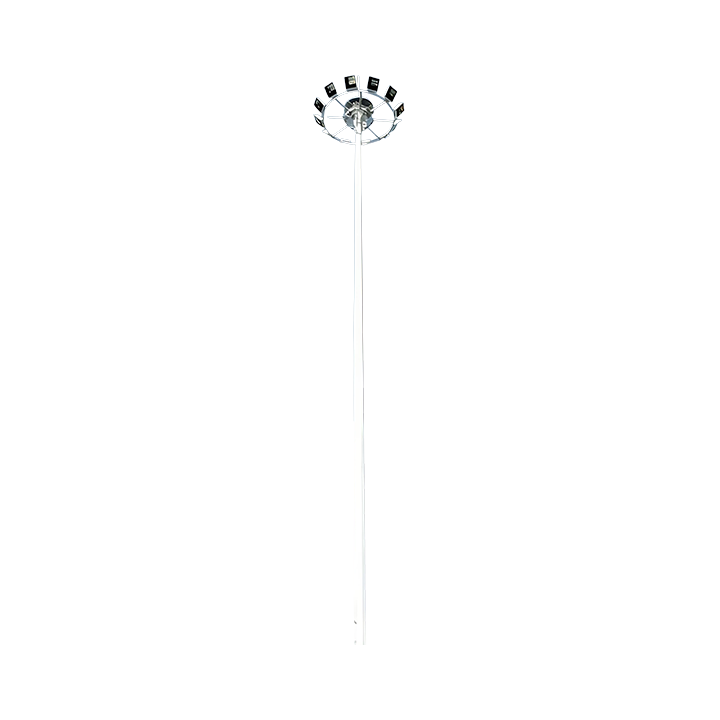
Pole / High-Mast Mounting |
High poles (typically 20–40 meters) installed around the perimeter of the stadium, with multiple fixtures mounted at the top; suitable for football fields and tracks |
|
Catwalk / Roof Mounting |
Fixtures installed on catwalks or roof trusses; suitable for indoor arenas and gymnasiums |
|
Column Mounting |
Lower-height columns installed around the venue; suitable for training fields, tennis courts, etc. |
|
Ground Projection |
Low-angle projection from the edge of the field; used for supplementary lighting or special effects |
8. Selection Guidelines & Industry Trends
Selection Guidelines:
Luminous Efficacy & Energy Efficiency: Choose products with luminous efficacy ≥150 lm/W to reduce operating energy costs
Light Distribution Solution: Select appropriate optical lenses based on field dimensions, mounting height, and fixture positions
Color Rendering: For TV broadcasts, ensure CRI ≥90
Intelligent Control: Prioritize products that support DMX512 or DALI dimming for flexible scene control
Ingress Protection: For outdoor use, require IP65 or higher; impact resistance IK08 or higher
Thermal Design: Good heat dissipation is critical for ensuring LED lifespan
Certification Standards: Reference JGJ 153-2016, CIE 83, IES LM-79, and other relevant standards
Industry Trends:
LED Fully Replaces Traditional Light Sources: LED stadium lights have gradually replaced metal halide lamps as the mainstream choice for new construction and retrofit projects
Smart Lighting Systems: Integration with IoT technology enables remote monitoring, energy consumption management, fault alerts, and automatic dimming
Integration with Stage Lighting: As sports venues become more multi-functional, sports lighting is increasingly integrated with stage lighting systems to meet both competition and entertainment needs
Lightweight & Modular Design: Fixture designs are trending toward lightweight and modular construction, facilitating installation, maintenance, and upgrades
Previous Post
What is a Solar Panel?
Next Post
What is a Solar Street Light?
Related Products
If you are interested in our products, please consult us
CONTACT DETAILS
-
Guoji Lighting Industrial Park,Northern Suburb of Yangzhou City

-
+86-0514-84242668

-
[email protected]

PRODUCTS
QUICK LINK
QR CODE
Copyright © JIANGSU TIANHUANG LIGHTING GROUP CO.,LTD. All Rights Reserved.
China LED street light manufacturer Custom metal street light pole supplier