 Language
 English
 русский
 Español
 عربى
عربى
Founded in January 2009, Jiangsu Tianhuang Lighting Group Co., Ltd. is a China Solar Lighting Panels Manufacturer and Custom Independent Solar Lighting Supplier, as well as a leading manufacturer of solar LED lighting, street lights, stadium lights, light poles, high mast poles, and highbay lights. The company was established after the merger of Huxi Lighting Factory, Longxiang (established in 2002), and Feilong (established in 2004), and is located in the well-connected and scenic Guoji Town, Gaoyou City, Yangzhou.
Jiangsu Tianhuang Lighting has actively contributed to key international projects, earning widespread recognition and trust from clients globally. The company operates from a 35,000-square-meter facility with advanced manufacturing equipment, including large-scale spraying machines, one-time forming folding machines, 10T cranes, and various welding and lighting assembly lines.
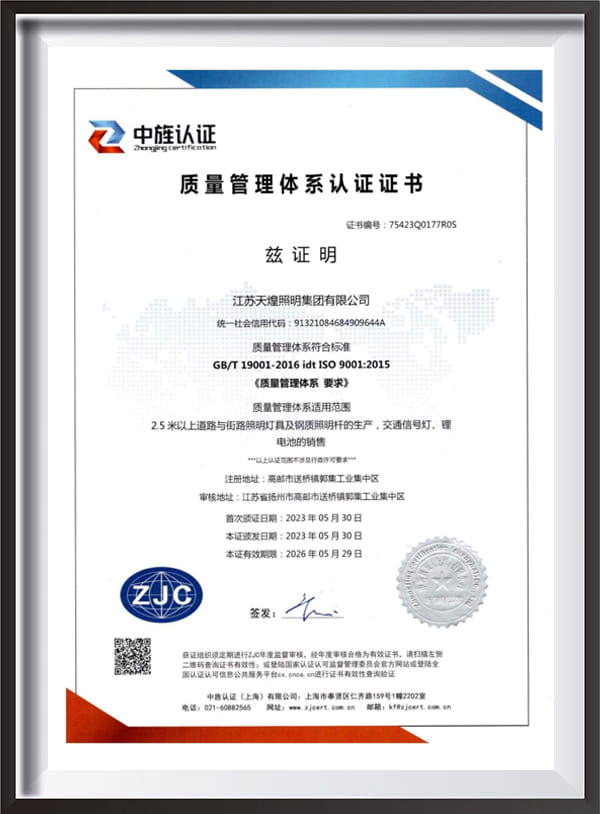
With a team of 125 employees, including 5 senior engineers and 40 skilled professionals, the company has established a solid reputation for product quality and innovation. Jiangsu Tianhuang Lighting has been recognized as an excellent enterprise by industrial and commercial departments for many consecutive years, earning certifications such as the 3C mandatory product certification, ISO9001, and CE. In 2018, the company was awarded the title of "Advanced Unit for Safety Production and Civilized Construction" by Jiangsu Province.

Solar Lighting Panels Manufacturer
information to be updated
About US
JIANGSU TIANHUANG LIGHTING GROUP CO.,LTD.
Certificate Of Honor







Related Products
latest News
-
Why Solar Street Lights Are Worth It: The Short Answer Solar street lights offer a compelling combination of zero electricity costs, easy off-grid installation...
READ MORE -
What are the advantages of LED street lights? LED street lights outperform conventional alternatives — including high-pressure sodium (HPS) and metal halide la...
READ MORE -
What is a galvanized light pole? A galvanized light pole is a steel or iron pole that has been coated with a protective layer of zinc through a hot-dip galvani...
READ MORE -
A solar street light is an independent lighting system that uses solar photovoltaic (PV) technology as its energy source, enabling road illumination at night wi...
READ MORE -
Hot-dip galvanizing is a metal anti-corrosion process. Steel components (such as light pole shafts) are immersed in a bath of molten zinc at approximately 450°C...
READ MORE -
A stadium light refers to a high-power, high-efficacy, high-reliability lighting system specifically designed for large sports venues and athletic fields. It is...
READ MORE
Industry knowledge
Independent solar lighting — also called off-grid or stand-alone solar lighting — is a complete lighting solution that operates entirely on energy harvested by a solar panel, without any connection to the utility grid. The system charges an internal battery during daylight hours and automatically illuminates during the night, making it one of the most self-sufficient outdoor lighting technologies available today. For municipalities, industrial parks, rural roads, sports venues, and logistics warehouses, this means light anywhere the sun shines — no trenching, no cable runs, no electricity bills.
The global solar street lighting market was valued at approximately USD 8.1 billion in 2023 and is projected to surpass USD 20 billion by 2030, driven by government electrification programs, falling photovoltaic module costs, and the urgent global push toward carbon-neutral infrastructure. Independent solar lighting sits at the center of this transition, because it eliminates grid-dependency entirely while delivering reliable, high-quality illumination wherever it is deployed.
Understanding how a solar panel powers an independent lighting system — and how to choose the right specifications — is the essential first step for anyone planning a project, whether it involves a single pathway light or hundreds of high mast poles across a national highway network.
How a Solar Panel Powers an Independent Lighting System
Every independent solar lighting unit is built around four core components: the solar panel (photovoltaic module), the battery storage unit, the LED light engine, and the smart controller. The solar panel converts photons into direct current (DC) electricity through the photovoltaic effect. Modern monocrystalline panels used in high-quality solar street lights achieve conversion efficiencies between 21% and 23%, a dramatic improvement from the 14–16% figures common a decade ago.
The controller manages charging cycles, protects the battery from overcharge and deep discharge, and triggers the LED driver at dusk. Advanced controllers use MPPT (Maximum Power Point Tracking) algorithms that extract up to 30% more energy from the panel compared to older PWM (Pulse Width Modulation) controllers — a difference that is especially significant during partial cloud cover or early morning and late afternoon hours.
Figure 1 illustrates the efficiency ratings of each major component in a modern independent solar lighting system. The solar panel itself converts only about 22% of incoming solar irradiance into usable electricity — a figure that highlights why panel quality and orientation are so critical. In contrast, the downstream components (MPPT controller, LiFePO4 battery, and LED driver) each operate at efficiencies above 90%, meaning that losses in those stages are minimal. The implication is clear: the quality and placement of the solar panel is the single greatest determinant of the entire system's energy output. Selecting a high-efficiency monocrystalline panel rather than a lower-grade polycrystalline module can increase energy yield by as much as 35% for the same physical panel area. This becomes especially important in regions with limited peak sun hours, where every percentage point of panel efficiency translates directly into more reliable all-night illumination.
Key Specifications: Choosing the Right Solar Panel for Your Lighting Project
Selecting the correct solar panel for an independent solar lighting system requires matching four variables: peak sun hours (PSH) at the installation site, the wattage of the LED fixture, the required operating hours per night, and the desired number of autonomy days (consecutive cloudy days the system can survive). A simplified sizing formula is:
Panel Watt-peak (Wp) = (LED Watts × Night Hours × Safety Factor) ÷ (PSH × System Efficiency)
For a 60W LED street light operating 11 hours per night in a location with 4.5 PSH, using a safety factor of 1.25 and a system efficiency of 0.85, the required panel is approximately 220 Wp. This calculation prevents under-sizing — a common mistake that results in the light dimming or switching off before dawn during winter months or overcast periods.
| Application | LED Wattage | Typical Panel Wp | Battery Capacity | Autonomy Days |
|---|---|---|---|---|
| Garden / Pathway Light | 10–20 W | 40–80 Wp | 30–60 Ah | 3 |
| Urban Street Light | 40–80 W | 150–300 Wp | 80–150 Ah | 3–5 |
| Stadium / Sports Venue | 200–600 W | 800–2000 Wp | 400–1200 Ah | 2–3 |
| High Mast Pole (Industrial) | 600–1200 W | 2400–5000 Wp | 1200–3000 Ah | 3–5 |
Annual Energy Output: Solar Panel Performance Across Seasons
One of the most frequently underestimated aspects of independent solar lighting design is seasonal variation in solar irradiance. A 200 Wp panel in Shanghai generates approximately 2.8 kWh on a clear December day but up to 5.6 kWh on a clear June day — a two-fold difference that must be absorbed by the battery bank or addressed through adaptive dimming algorithms. Smart controllers can automatically reduce LED output by 30–50% during the second half of the night, ensuring the battery never fully depletes even during the shortest winter days.
Figure 2 reveals a critical seasonal asymmetry in solar panel output that designers must account for when specifying independent solar lighting systems. At Shanghai (31°N latitude), daily output from a 200 Wp panel drops from a summer peak of about 5.6 kWh to a winter low of roughly 2.8 kWh — meaning the battery bank sized for winter conditions will be substantially oversized for summer use. Guangzhou (23°N) benefits from higher overall irradiance and a less severe winter dip, making it a more forgiving environment for independent solar lighting deployment. The lesson for procurement teams and system integrators is that solar panel sizing must always be based on the worst-month scenario, not the annual average — otherwise the system will fail to deliver adequate illumination during the coldest, darkest months when roadway safety is most critical. Furthermore, the use of tilt-adjustable mounting brackets allows the panel angle to be optimized seasonally, potentially recovering 10–15% of winter output in higher-latitude installations.
Independent Solar Lighting vs. Grid-Connected Systems: A Comparative Analysis
The decision between independent solar lighting and conventional grid-connected street lighting is ultimately an economic and logistical calculation. For projects within 50 meters of an existing grid connection, grid power often remains cheaper on a pure capital-cost basis. However, once grid extension costs are included — typically USD 10,000–30,000 per kilometer of new cable trench in China — independent solar lighting becomes the lower-cost option for most rural and suburban roads, industrial parks, and remote facilities.
The 25-year lifecycle cost comparison is particularly striking. A standard grid-connected 60W street light accumulates approximately USD 3,200 in electricity costs over 25 years (at CNY 0.6/kWh, 11 hours/night). An equivalent independent solar lighting unit has zero electricity cost — and the incremental hardware premium (better panel, larger battery) is typically recovered within 5–7 years.
Figure 3 makes the 25-year cost story unmistakable. While grid-connected lighting requires a lower initial capital investment, the cumulative electricity tariff cost dwarfs the hardware savings — resulting in a total lifecycle cost of approximately USD 4,650 per light point. Independent solar lighting reverses this profile: a higher upfront capital cost is offset entirely by zero electricity expense, yielding a lifecycle total of roughly USD 1,450 — a saving of over USD 3,200 per unit. For a project involving 500 street lights, this translates to a total savings of approximately USD 1.6 million over 25 years, without factoring in grid extension costs or future electricity tariff increases. Maintenance costs are also substantially lower for independent solar lighting because there are no underground cables to repair or utility coordination requirements. This financial picture explains why independent solar lighting has become the default choice for new infrastructure in developing regions and remote industrial sites globally.
Solar Panel Technology Types and Their Impact on Lighting Performance
Not all solar panels perform equally in independent solar lighting applications. The three commercially dominant technologies — monocrystalline silicon, polycrystalline silicon, and thin-film — each carry distinct performance trade-offs relevant to outdoor lighting systems.
- Monocrystalline: Efficiency 20–23%, best low-light performance, longest lifespan (25+ years), highest cost per Wp. Ideal for constrained mounting areas and high-latitude sites.
- Polycrystalline: Efficiency 15–18%, moderate cost, acceptable performance in strong sunshine regions. Common in warm-climate street lighting projects.
- Thin-Film (CIGS/CdTe): Efficiency 10–13%, best high-temperature performance, flexible form factors, lowest cost per m². Used in specialty applications where panel weight is critical.
For most independent solar lighting applications — especially street lights, stadium lights, and high mast poles — monocrystalline PERC (Passivated Emitter and Rear Cell) panels are the current standard of excellence. PERC technology adds a reflective layer on the rear of the cell, increasing photon capture and delivering efficiency gains of 1–2 percentage points above standard monocrystalline, particularly at low angles of incidence typical of dawn and dusk.
The radar chart (Figure 4) provides a holistic visual comparison of the three main solar panel technologies across six performance dimensions critical to independent solar lighting. Monocrystalline panels dominate in efficiency, lifespan, and low-light performance — the three factors most directly tied to reliable nightly illumination — which is why they are the preferred choice for commercial and municipal street lighting projects. Polycrystalline panels offer a reasonable balance, excelling in cost efficiency while delivering acceptable performance in sunny climates where low-light sensitivity is less critical. Thin-film technology stands out in two dimensions: high-temperature performance and installation flexibility, making it relevant for specialty applications such as integrated pole-top panels in hot desert environments or curved architectural installations. For a project manager specifying an independent solar lighting system in a temperate or northern climate, the radar chart clearly points toward monocrystalline as the dominant choice — the advantages in efficiency and low-light performance translate directly into more hours of illumination per night and more days of autonomous operation when cloudy weather prevails.
Applications of Independent Solar Lighting: From Street Lights to Stadium Lights
The versatility of solar panel-powered independent lighting makes it suitable for an exceptionally wide range of applications. Below are the most commercially significant use cases, each presenting unique design considerations.
Solar Street Lights and Road Lighting
Solar street lights represent the largest single segment of the independent solar lighting market. A well-designed system uses a monocrystalline solar panel mounted atop or alongside the light pole, feeding a lithium iron phosphate (LiFePO4) battery integrated into the pole housing. LiFePO4 chemistry offers over 2,000 charge cycles at 80% depth of discharge — roughly 7–8 years of daily cycling — before capacity falls below 80%. This far exceeds the cycle life of older lead-acid battery systems, reducing replacement costs and landfill burden.
Stadium Lights and Sports Venue Illumination
Sports venues and stadiums present a more demanding independent solar lighting challenge: high wattage (200–600W per fixture), concentrated usage hours (typically evening peak), and strict uniformity requirements. Solar-powered stadium lights typically deploy large panel arrays on canopy or perimeter structures, combined with high-capacity battery banks. The result is a zero-grid facility that can host evening events, broadcast-quality matches, and community activities without drawing from the utility network.
High Mast Poles and Industrial Area Lighting
High mast poles — typically 15 to 40 meters tall — are used in ports, logistics yards, airports, and large industrial facilities. Independent solar lighting at this scale requires panel arrays of 2,400 to 5,000 Wp per mast, with centralized battery cabinets. The economic rationale is especially compelling for remote industrial facilities where grid extension costs can reach USD 80,000 per kilometer in challenging terrain.
Highbay Lights in Covered Facilities
Solar-powered highbay lights serve warehouses, agricultural sheds, and covered loading docks in off-grid locations. Panel arrays are roof-mounted, and the LED highbay fixtures operate from a shared DC bus — often 48V or 96V — that distributes power efficiently across multiple light points from a single charge controller and battery bank.
Street lighting dominates the independent solar lighting market with approximately 38% of global installed capacity, reflecting the enormous scale of road infrastructure investment worldwide. Stadium and sports lighting accounts for 18%, driven by growing demand for electrified community and professional sports facilities in regions with unreliable grid power. High mast pole lighting (16%) and highbay lighting (14%) collectively represent 30% of the market, reflecting significant industrial and logistics adoption. The diversity of this application landscape underscores the flexibility of solar panel-based independent lighting as a platform technology: the same fundamental components — monocrystalline panel, LiFePO4 battery, MPPT controller, LED driver — can be scaled and configured to serve everything from a pedestrian path to a 40-meter industrial mast. This scalability is one of the most compelling arguments for standardizing on independent solar lighting across diverse infrastructure programs.
Installation Best Practices for Independent Solar Lighting Systems
Achieving optimal performance from an independent solar lighting system depends as much on correct installation as on component quality. The following practices are essential for maximizing solar panel output and system longevity.
- Panel orientation: In the Northern Hemisphere, panels should face due south; in the Southern Hemisphere, due north. Deviation of more than 20° from true south reduces annual output by 5–10%.
- Tilt angle: The optimal fixed tilt angle is approximately equal to the site latitude. For example, at 30°N (Shanghai), a 30° tilt maximizes annual yield. Adjustable brackets add 8–12% annual output.
- Shading avoidance: Even partial shading of a solar panel dramatically reduces output due to the series connection of cells. A shadow covering just 5% of the panel area can reduce output by up to 30%. Site surveys must identify trees, buildings, and existing poles that may cast shadows during critical morning or afternoon hours.
- Panel cleaning schedule: Dust, bird droppings, and pollution deposits reduce output by 5–25% depending on location. In desert or industrial zones, monthly cleaning is recommended; in clean rural environments, quarterly cleaning is generally sufficient.
- Cable sizing and management: Undersized cables between the panel and controller introduce resistive losses. Use cables sized for a maximum voltage drop of 1% under peak current conditions. Protect all cable runs in UV-resistant conduit.
- Battery temperature management: LiFePO4 batteries should not be charged below 0°C without a low-temperature protection circuit. In cold climates (below −20°C), insulated battery enclosures or heating elements are necessary to prevent irreversible capacity loss.
Smart Control Technology: Maximizing Solar Panel Utilization
Modern independent solar lighting systems are increasingly intelligent. Smart controllers now incorporate GPS-synchronized dusk-to-dawn timers, multi-level dimming profiles, wireless remote monitoring, and even AI-based load forecasting that adjusts LED output based on predicted cloud cover from weather API data. These features transform what was once a simple on/off device into a sophisticated energy management platform.
A typical smart dimming profile reduces LED output to 50% during midnight hours (when traffic is minimal) and restores full brightness at 5:00 AM. This simple strategy extends battery autonomy by approximately 35% compared to running at full power all night — effectively allowing the system to survive two additional consecutive cloudy days without recharging.
Remote monitoring platforms — accessible via smartphone app or browser dashboard — provide real-time data on battery state of charge, panel output voltage, LED driver status, and fault codes. For municipal projects managing hundreds or thousands of light points, this visibility dramatically reduces maintenance costs by enabling predictive servicing rather than reactive repair after failures.
About Jiangsu Tianhuang Lighting Group Co., Ltd.
Founded in January 2009, Jiangsu Tianhuang Lighting Group Co., Ltd. is a leading manufacturer of solar LED lighting, street lights, stadium lights, light poles, high mast poles, and highbay lights in China. The company was established after the merger of Huxi Lighting Factory, Longxiang (established in 2002), and Feilong (established in 2004), and is located in the well-connected and scenic Guoji Town, Gaoyou City, Yangzhou. With over two decades of combined manufacturing heritage and a dedicated focus on independent solar lighting solutions, Jiangsu Tianhuang Lighting Group brings deep engineering expertise and rigorous quality standards to every product — from the solar panel mounting systems to the LED optical assemblies and smart control electronics. The company's integrated manufacturing capabilities allow precise control over every component in the independent solar lighting value chain, ensuring consistent performance across large infrastructure deployments worldwide.
Frequently Asked Questions
If you are interested in our products, please consult us
CONTACT DETAILS
-
Guoji Lighting Industrial Park,Northern Suburb of Yangzhou City

-
+86-0514-84242668

-
[email protected]

PRODUCTS
QUICK LINK
QR CODE
Copyright © JIANGSU TIANHUANG LIGHTING GROUP CO.,LTD. All Rights Reserved.
China Solar Lighting Panels Manufacturer Custom Independent Solar Lighting Supplier